Cybershield IT recommends AI threat detection and response. AI in security operations lets organizations detect risks early, respond quickly, and avoid costly breaches.
This article discusses how AI is changing cybersecurity, how it affects your organization, and why forward-thinking companies are using advanced cyber threat detection technologies.
What Is AI-Based Threat Detection and Incident Response?
AI-based threat detection and incident response refer to the use of artificial intelligence, machine learning, and behavioral analytics to:
- Detect anomalies and malicious activity in real time
- Correlate security events across systems
- Prioritize high-risk alerts
- Automate containment and remediation actions
Unlike traditional rule-based systems that rely on predefined signatures, machine learning cyber threat detection continuously analyzes data patterns to identify new, unknown, and zero-day threats.
When paired with AI-powered incident response, organizations move from reactive security to proactive defense, where systems don’t just alert but actively respond.
Challenges of Manual Threat Detection Methods
Organizations used manual monitoring, rule-based detection, and human-driven investigations before AI became crucial to cybersecurity. Although these methods formed the basis of modern defenses, they are no longer effective against highly automated and fast-developing threats.
Below, we examine the main drawbacks of manual threat detection and why firms are using AI.
1. Alert Fatigue and Overwhelming Data Volume
Modern IT settings create significant security data every second. All firewalls, intrusion detection systems, antivirus software, cloud platforms, and endpoints log and alarm.
This causes alert fatigue, as analysts are too busy to spot real threats. Attackers weave harmful activity into operational noise to exploit this weakness.
AI-driven solutions correlate warnings and assign intelligent risk scores to focus analysts on high-risk situations, greatly reducing this strain.
2. Limited Cross-Platform Visibility
Manual detectors work in silos. This fragmented visibility inhibits security teams from seeing the whole attack chain.
An attacker may:
- Compromise an email account
- Use stolen credentials to access cloud resources
- Move laterally across endpoints
If each task is reviewed separately, the pattern may be missed. Real-time correlation of multi-stage attacks is difficult for manual systems.
Businesses investing in advanced cyber threat detection solutions emphasize AI-powered, unified monitoring across environments.
3. Slow Detection and Response Times
Even highly skilled analysts require time to validate alerts, gather context, and determine next steps. Unfortunately, modern cyber threats move much faster:
- Ransomware can encrypt systems in minutes
- Data exfiltration can occur silently within hours
- Lateral movement across networks happens almost instantly
Dwell time increases financial and operational damage from undetected threats.
The lack of AI-powered incident response sometimes delays containment until vital assets are compromised.
4. Dependence on Signature-Based Detection
Traditional security systems use signatures, predetermined patterns that match malware or attack tactics.
Attackers constantly develop signature-evasion methods.
Manual detection cannot keep up with quick changes. Machine learning cyber threat detection is more successful against unknown threats because it detects abnormalities based on behavior rather than static signatures.
5. High Operational Costs and Resource Constraints
Many small and mid-sized organizations cannot build this degree of internal expertise. Cybersecurity talent shortages affect even larger companies.
This dilemma highlights why SMBs should outsource IT security to vendors who use automation and AI to scale protection without adding staff.
6. Inconsistent Incident Handling
Inconsistency raises critical incident risk. A delayed containment decision or misclassified alarm can escalate a minor breach.
AI-based incident response performs predetermined playbooks promptly and reliably, removing ambiguity in high-pressure situations.
Predictive Threat Detection Using Machine Learning
Traditional cybersecurity tools are designed to detect threats that already exist. They rely on known indicators of compromise, predefined rules, and historical attack signatures. While this approach is useful, it leaves organizations vulnerable to new, evolving, and previously unseen threats.
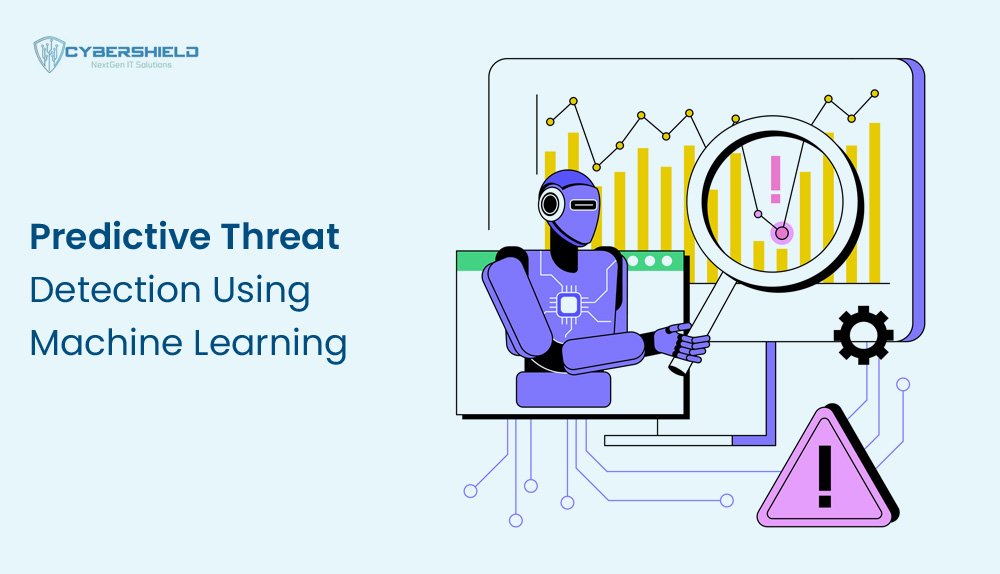
Predictive threat detection powered by machine learning changes the equation entirely. Instead of waiting for an attack to match a known pattern, AI systems analyze behaviors, trends, and anomalies to anticipate malicious activity before it fully unfolds. This is one of the most powerful advantages of modern AI threat detection and response.
How Machine Learning Anticipates Threats
Machine learning in cybersecurity works by continuously refining its understanding of risk. It does this through:
- Pattern Recognition at Scale
AI can process millions of events per second across endpoints, servers, cloud platforms, and network devices. It detects patterns humans simply cannot see in real time. - Anomaly Detection Models
When a system suddenly behaves outside its baseline, such as a finance employee accessing engineering databases, the AI assigns a risk score and flags the activity for investigation. - Threat Modeling Based on Historical Attacks
By analyzing past breach tactics, machine learning models recognize the sequence of actions attackers typically follow. This enables early identification of multi-stage attacks. - Continuous Learning
Unlike static security rules, machine learning improves over time. The more data it processes, the more accurately it predicts malicious behavior.
This continuous adaptation is what makes machine learning cyber threat detection essential for defending against advanced persistent threats (APTs) and zero-day vulnerabilities.
Also Read: How CyberShield Uses AI to Detect and Respond to Cyber Attacks
Automating Incident Response Workflows with AI
In cybersecurity, speed determines impact. The difference between a minor security incident and a full-scale breach often comes down to how quickly an organization can detect, contain, and remediate a threat. Unfortunately, traditional incident response workflows are heavily manual, relying on alert reviews, ticket escalation, human validation, and step-by-step containment procedures.
AI transforms this process by introducing intelligent automation into every stage of the response lifecycle. With automated incident response using AI, security systems no longer just alert, they act.
As businesses expand their infrastructure, adding cloud platforms, remote users, and connected devices, the volume of security alerts grows exponentially.
Manual response processes simply cannot scale at the same pace.
With advanced cyber threat detection solutions powered by AI, organizations can maintain rapid and consistent incident handling across:
- On-premises networks
- Hybrid cloud environments
-
Remote endpoints
- SaaS applications
Final Thoughts
Cybersecurity now requires intelligent reaction, not just prevention.
Real-time detection, predictive analytics, and automated containment are changing how corporations fight modern threats using AI.
For organizations willing to improve their defenses with AI threat detection and response, Cybershield IT provides specialized, proactive security solutions to protect and elevate operations in a complex digital world.
Read more: AI-Driven IT Shield Solutions for 24/7 Protection