
That’s the break-fix model, and it’s how most small businesses still handle IT. It feels straightforward until you add up what it actually costs: the downtime while you wait for a technician, the lost productivity while employees sit idle, the data that’s gone because nobody was monitoring the backup, and the security breach that happened three weeks ago but wasn’t detected until a client complained.
The debate between proactive vs reactive IT support isn’t theoretical anymore. The data is clear. Organizations running proactive IT monitoring resolve 80% of potential issues before anyone notices a problem, cut overall IT costs by up to 30%, and reduce cybersecurity risk by 60% compared to reactive approaches. Reactive IT support, by contrast, leaves businesses perpetually one step behind the problem.
Here’s why that gap keeps widening.
What Is Reactive IT Support?
Reactive IT support is exactly what it sounds like: you react after something goes wrong. A server crashes, a workstation won’t boot, an employee gets locked out of their email. You call your IT person or company, they come fix it, and you get a bill based on the time and parts involved.
This is the traditional break-fix model. No ongoing relationship. No monitoring. No prevention. Just repair work when things fail. It served businesses well enough in the 1990s and early 2000s when IT was simpler and cyberattacks were rare. In 2026, it’s a liability.
What Is Proactive IT Monitoring?
Proactive IT monitoring flips the model entirely. Instead of waiting for failure, IT monitoring services continuously watch your systems, networks, endpoints, and security posture in real time. Automated alerts catch problems early, often before they affect a single user. Patches get applied on schedule. Backups get tested regularly. Threats get detected at the first sign of unusual activity, not after the damage is done.
Think of it as the difference between annual checkups with bloodwork versus only going to the hospital after a heart attack. One approach catches problems when they’re small and treatable. The other waits until they’re expensive and dangerous.
Read More Blog: Managed IT Services in 2026: What Modern Businesses Really Need
Problems with the Break-Fix IT Model
The break-fix model has a structural problem that no amount of good intentions can fix: the financial incentives are backwards. Your IT provider makes money when things break. They have zero incentive to prevent problems because prevention means fewer billable hours.
Beyond the incentive misalignment, break-fix creates several operational risks. There’s no monitoring between service calls, so issues compound silently. Response times depend entirely on technician availability, which during a busy week could mean waiting days. Every incident starts from scratch because there’s no documentation of your environment. And because nobody is watching your security posture, you won’t know you’ve been breached until it’s far too late.
The Hidden Cost of IT Downtime
Downtime costs more than most business owners realize. The widely cited figure is $5,600 per minute, though more recent 2024 research from EMA puts the average at $14,056 per minute across all organization sizes. For larger enterprises, that number climbs to $23,750 per minute.
Even for a 20-person company, a two-hour outage means lost productivity across every employee, missed client communications, potential revenue loss from interrupted operations, and the emergency repair bill on top of it all. The businesses running reactive IT support absorb these costs regularly because they have no system in place to prevent the outages in the first place.
How Proactive Monitoring Prevents Issues Early
The core benefit of proactive IT monitoring is catching problems during the warning stage, not the failure stage. A hard drive showing early signs of degradation gets replaced before it crashes and takes your data with it. A server running low on memory gets an upgrade before it starts dropping connections. A firewall rule conflict gets fixed before it opens a security gap.
Organizations implementing proactive monitoring can achieve up to 99.9% operational uptime. That’s not a marketing number. It’s the result of eliminating the small failures that cascade into big ones when nobody is watching.
24/7 System Monitoring and Alerts
Your business might operate 9 to 5, but your systems run around the clock. A server failure at 2 AM on a Saturday doesn’t wait for Monday morning to cause damage. With 24/7 IT monitoring services, automated systems detect anomalies the moment they occur and trigger alerts to on-call engineers who can respond immediately.
CyberShieldIT’s MSSP Security Operations Center provides managed security services tailored for SMBs with round-the-clock monitoring that catches threats and system issues regardless of when they happen.
Reducing Cybersecurity Risks with Early Detection
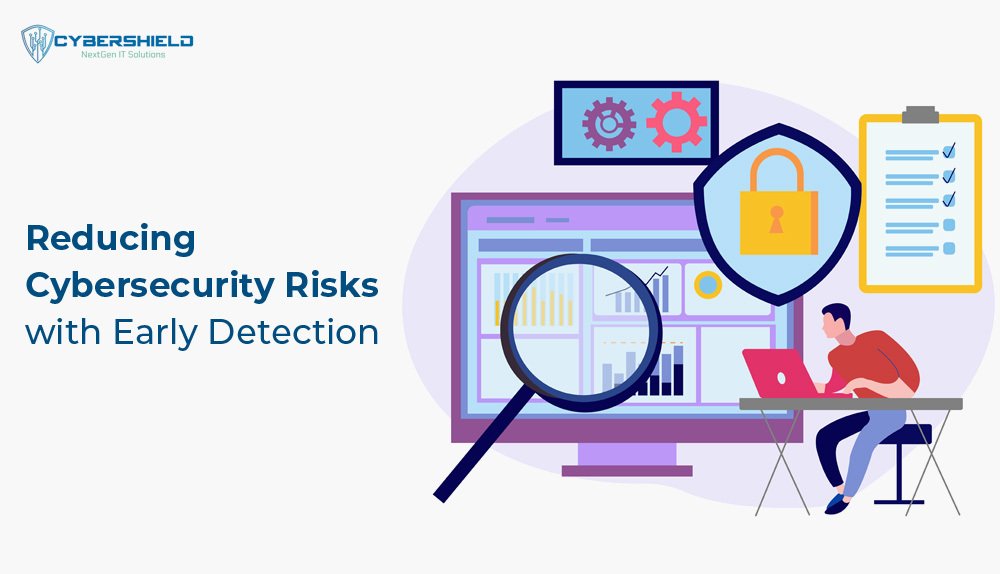
Cybersecurity is where the gap between proactive and reactive approaches becomes most dangerous. The average data breach takes 181 days to detect. That’s six months of an attacker moving through your systems, accessing data, and establishing persistence before anyone notices.
Proactive monitoring cuts that window dramatically. Organizations with proactive threat monitoring reduce their cybersecurity risk by 60%, and ransomware attacks decreased by 75% for businesses that implemented continuous monitoring. Early detection means catching unusual traffic patterns, unauthorized access attempts, and suspicious file activity before an attacker achieves their objective.
Learn how CyberShieldIT uses AI to detect threats before they become breaches with our AI-driven IT Shield solutions that combine automated threat intelligence with human oversight.
Businesses also need to protect their stored information. Read our guide on database security best practices to understand how proactive monitoring extends to your data layer.
Faster Issue Resolution Before Users Notice
With reactive IT support, the clock starts when someone reports a problem. With proactive monitoring, the clock starts when the system detects an anomaly, often minutes after it begins. Automated remediation handles routine issues instantly: restarting a stalled service, clearing a full log drive, or escalating a hardware alert to a technician before the user experiences any disruption.
IT team efficiency improves by 40% under proactive management because engineers spend their time on planned improvements rather than emergency firefighting.
Improving Employee Productivity
Every minute an employee spends waiting for a frozen application, a crashed workstation, or a slow VPN connection is a minute they’re not doing their job. Those minutes add up. Across a 50-person company, even 15 minutes of daily IT friction per employee totals over 3,000 hours of lost productivity per year.
Proactive IT monitoring keeps systems running smoothly so your team stays focused on their actual work. Fewer interruptions, faster performance, and issues resolved before they reach the helpdesk.
Better Network Performance and Stability
Network performance degrades gradually. Bandwidth saturation, misconfigured switches, DNS issues, and aging hardware all contribute to slowdowns that users notice but can’t articulate beyond “the internet is slow today.” Proactive monitoring tracks network health continuously: latency, packet loss, throughput, and device status. When performance starts drifting outside acceptable ranges, the system flags it and your IT team addresses it before it impacts operations.
Predictable IT Costs with Managed Services
One of the most practical benefits of proactive IT support is cost predictability. Break-fix billing is inherently unpredictable. You might spend $500 one month and $8,000 the next, depending on what breaks. Managed IT monitoring services operate on a flat monthly fee that covers monitoring, maintenance, patching, security, and helpdesk support.
According to CompTIA, 46% of managed IT service users have cut their IT costs by 25% or more. The savings come from fewer emergencies, longer hardware lifespans, and the elimination of after-hours premium rates for urgent break-fix calls.
Data Backup and Disaster Prevention
Backups are only as good as your last successful test. Under a reactive model, many businesses discover their backups have been failing silently for weeks or months, usually at the worst possible moment. Proactive monitoring tracks backup success rates daily, verifies data integrity, and alerts your team immediately when a job fails.
That difference matters enormously when ransomware hits. A business with verified, tested backups can refuse to pay the ransom and restore operations. A business with untested backups rolls the dice.
Supporting Remote and Hybrid Work
Remote and hybrid workforces expand your attack surface and your IT complexity. Home networks, personal devices, unsecured Wi-Fi, and VPN connectivity all introduce variables that a reactive model simply can’t manage. Proactive IT monitoring extends coverage to every endpoint regardless of location, ensuring that a remote employee’s laptop gets the same security updates, monitoring, and support as an in-office workstation.
Using Automation and AI for Smarter IT
Modern proactive IT monitoring increasingly relies on AI and automation to handle the volume and speed of today’s threat environment. AI-driven IT Shield solutions analyze patterns across thousands of data points to identify anomalies that human operators would miss. Automated playbooks handle routine remediation instantly: isolating a compromised endpoint, blocking a suspicious IP, or escalating a complex incident to a senior engineer.
Be aware of social engineering threats too. See how the Microsoft Account Team email scam works and why proactive monitoring catches these attacks before employees fall for them.
Organizations using AI-powered security tools detect breaches 80 days faster and save $1.9 million compared to those without. That’s the kind of ROI that makes the proactive vs reactive IT support debate a settled question.
Long-Term IT Strategy vs. Short-Term Fixes
Reactive IT support traps businesses in a cycle of short-term fixes. Every dollar goes toward putting out the current fire, leaving nothing for strategic improvements. Proactive monitoring frees your IT budget and attention for the work that actually moves your business forward: cloud migration planning, infrastructure upgrades, security maturation, and technology roadmaps aligned with your growth goals.
Why Businesses Are Moving to Proactive IT Models
The shift is already happening at scale. The global managed services market reached $270 billion in 2023 and is projected to exceed $878 billion by 2032. Businesses are making this move because the math is straightforward: proactive IT monitoring costs less, protects more, and creates the operational stability that growth requires.
The benefits of proactive IT support compound over time. Year one, you stabilize operations and eliminate emergency costs. Year two, you start making strategic improvements with the budget you freed up. Year three, your IT infrastructure becomes a competitive advantage instead of a cost center.
Make the Switch to Proactive IT with CyberShieldIT
CyberShieldIT provides managed security services tailored for SMBs that replace reactive firefighting with proactive protection. Our ITShield service delivers 24/7 monitoring, automated alerting, patch management, and helpdesk support on a predictable monthly fee. CyberShield adds layered threat detection with our MSSP Security Operations Center watching your environment around the clock. Cloud Shield protects your cloud infrastructure, and Comm Shield secures your communications.
Stop waiting for things to break. Start preventing them. Schedule a Free IT Assessment or Call us: 813-920-0085