Businesses are now exposed to increasingly sophisticated cyber threats. As businesses adopt cloud platforms, remote work models, and interconnected digital ecosystems, cybercriminals are evolving just as quickly. They are often faster than internal defenses can keep up.
Cybersecurity services are essential for securing sensitive data and vital infrastructure. Cybersecurity is no longer reactive for modern enterprises, especially SMEs. Managed security services help. They offer proactive, intelligence-driven cyber threat prevention to meet regulatory standards and combat today’s quickly evolving threat scenario.
Why Cyber Threats Are Increasing in the Modern Digital Landscape
The rise in cyber threats is closely tied to digital transformation. Cloud adoption, SaaS platforms, IoT devices, and mobile workforces have dramatically expanded the attack surface for organizations. Threat actors are fast to take advantage of each new application, endpoint, or third-party integration that could have security holes.
At the same time, cybercrime has become very organized and profitable. Attackers increasingly act like businesses, leveraging automation, malware-as-a-service, and advanced reconnaissance methods to find easy targets.
Many organizations don’t even know they’ve been hacked until a lot of damage has already been done, unless they keep an eye on things and use advanced detection. Managed services are quickly becoming the future of cybersecurity. They give businesses the tools, knowledge, and resources they need to stay ahead of new threats.
The Impact of Remote Work on Rising Cyberattacks
Remote and hybrid work environments have fundamentally changed how employees access corporate systems. Remote endpoints, cloud environments, and distributed users can all benefit from enterprise-grade monitoring and protection through managed security services, which help to bridge this gap.
1) Expanded attack surfaces beyond the office perimeter
Traditional network boundaries have disappeared with remote work. Staff use home networks, shared Wi-Fi, and personal devices to access company systems, many of which lack enterprise-grade security. Attackers have many additional entry points with this expansion.
2) Increased reliance on unsecured endpoints and personal devices
Laptops, smartphones, and tablets used outside the office often miss critical updates, endpoint protection, or encryption. Cybercriminals seek these weaker endpoints to enter corporate networks.
3) Surge in phishing and credential-based attacks
Email, chat apps, and cloud collaboration tools are crucial for distant workers. This reliance allows attackers to use advanced phishing to steal login credentials, bypass MFA, and impersonate trusted coworkers and vendors.
4) Reduced visibility for internal IT teams
Monitoring user activity across distributed environments is far more complex than securing a centralized office network. Many internal IT teams don’t have the right tools or enough workers to keep an eye on things in real time, which lets suspicious activity go unreported for longer.
Why Small and Mid-Sized Businesses Are Prime Targets
Contrary to popular belief, cybercriminals increasingly target SMBs, not because they hold less data, but because they often lack robust security infrastructure. Many SMBs rely on limited IT support and outdated security tools, making them easier entry points for attackers.
SMBs are also often linked to bigger companies through supply chains, which makes them good places for bigger attacks to start. One compromised vendor can put many businesses at risk.
Managed security services provide SMBs with access to the same level of protection used by larger enterprises, without the cost or complexity of building in-house security operations.
How MSSPs Use AI and Threat Intelligence to Stop Attacks
Artificial intelligence and real-time threat intelligence are essential in combating today’s high-volume, fast-moving attacks. MSSPs use AI-driven analytics to identify patterns, detect anomalies, and reduce false positives that overwhelm internal teams.
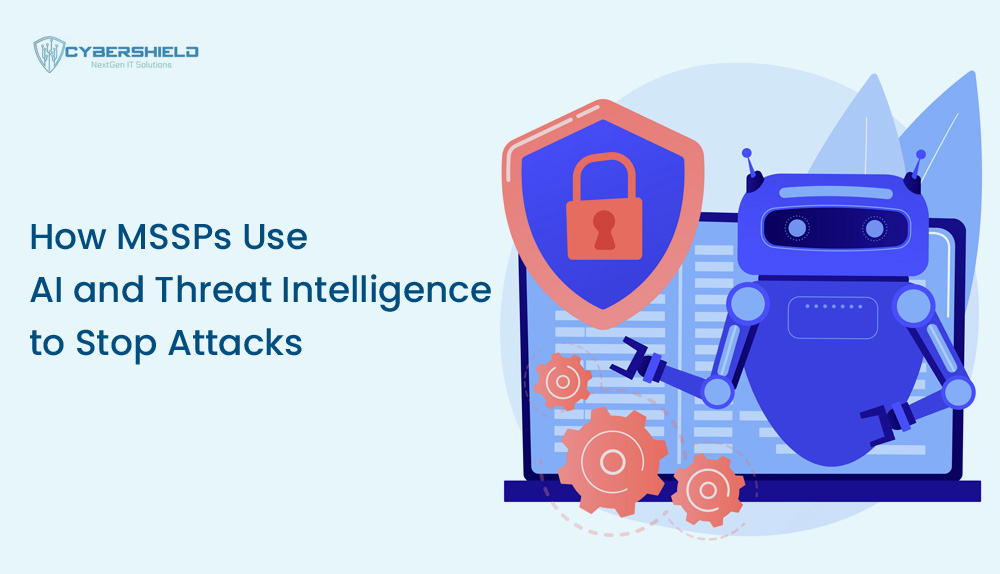
Threat intelligence feeds provide up-to-date insights into emerging threats, attacker techniques, and known malicious infrastructure. By combining AI with global intelligence, managed security services stay ahead of evolving cyber threats rather than reacting after the fact.
Why Internal IT Teams Alone Can’t Handle Today’s Cyber Threats
Keeping up with regular operations, user assistance, and infrastructure maintenance can put a strain on internal IT personnel. It is unreasonable to expect them to coordinate incident response, compliance, and advanced threat detection as well.
Expertise, ongoing education, and cutting-edge technology are necessities in the cybersecurity industry. With the help of managed security services, internal teams may concentrate on future-proofing IT and scaling IT with your business, because these services offer deep experience, scalability, and ongoing protection.
How MSSPs Help Businesses Stay Compliant With Regulations
Regulatory requirements around data protection and cybersecurity continue to grow across industries. Compliance failures can result in heavy fines, legal exposure, and reputational damage.
Managed security services support compliance by implementing standardized controls, maintaining audit-ready documentation, and continuously monitoring systems for policy violations. This is especially critical for organizations operating in regulated environments or managing sensitive data tied to BIA cybersecurity frameworks.
Looking ahead, cyber threats will continue to increase in complexity, automation, and impact. AI-driven attacks, supply chain compromises, and cloud-based exploits are expected to dominate the next wave of cybersecurity challenges.
Managed security services like Cybershield IT will be very important for businesses to stay one step ahead of these threats. They provide adaptive, intelligence-led protection that changes as the threat landscape changes.