

Key Takeaways
- A SIEM finds and flags problems. MDR actually stops them.
- Without people watching, SIEM alerts often go unread until it’s too late.
- MDR includes analysts, tools, and 24/7 coverage for one monthly fee.
- Regulated businesses may keep a SIEM for log retention and add MDR on top.
- Ask who would respond to an alert at 2 a.m. on a weekend before you buy anything.
- CyberShield IT pairs monitoring with real response for Tampa Bay businesses.
It happens more often than you’d think. A company spends real money on a SIEM. It gets installed, connected to the firewall and servers, and starts producing alerts. Hundreds of them a day. Six months later, a ransomware attack hits, and when everyone looks back, the warning signs were sitting right there in the logs. Nobody had time to read them.
That’s the heart of the MDR vs SIEM question. One of these tools tells you something might be wrong. The other sends people to deal with it.
What Is a SIEM?
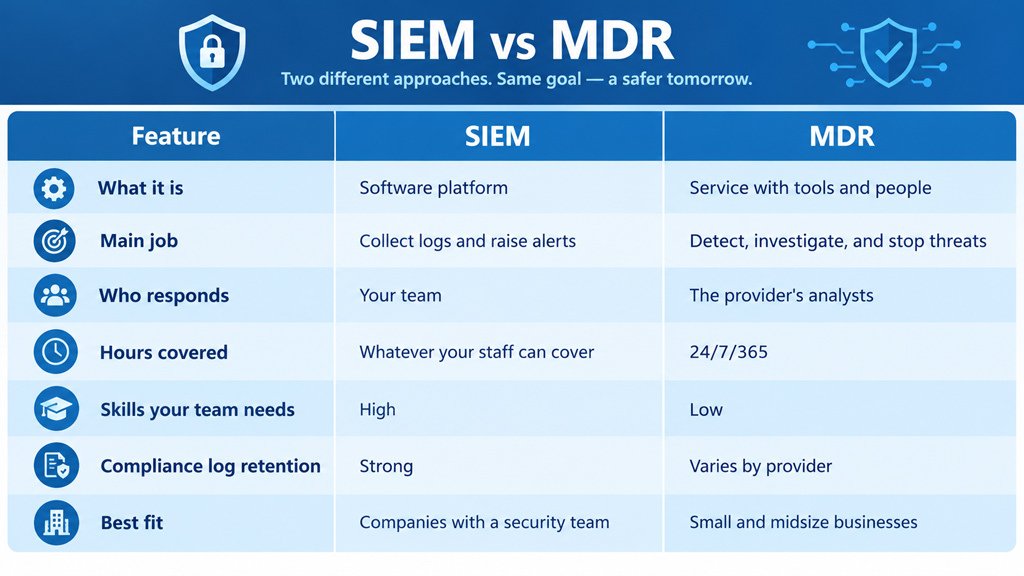
SIEM stands for security information and event management. It’s software that pulls logs from across your environment, things like firewalls, servers, Microsoft 365, endpoints, and cloud apps, and puts them in one place. Then it applies rules to spot patterns that look suspicious.
A good SIEM can tell you that someone logged in from two countries within an hour, or that an account suddenly downloaded thousands of files at 2 a.m.
SIEMs also help with compliance, since PCI DSS and HIPAA expect you to collect and review logs.
But a SIEM is a tool. It doesn’t investigate or decide whether an alert is real. And it definitely doesn’t log into your network at 3 a.m. to isolate an infected laptop.
What Is MDR?
MDR stands for managed detection and response. It’s a service, not just software. You get a team of security analysts who watch your systems around the clock, investigate suspicious activity, and take action to stop attacks.
MDR providers bring their own tools, usually endpoint detection and response (EDR) plus cloud monitoring, and an analyst digs into anything odd within minutes. If it’s a real threat, they contain it. That could mean cutting a device off the network, disabling a compromised account, or killing a malicious process before it spreads.
Then they tell you what happened in plain English and help you fix the root cause.
The Real Difference: Alerts vs Action
Picture a smoke detector and a fire department.
The SIEM is a very smart smoke detector wired into every room of the building. It sounds the alarm, but it can’t grab a hose.
MDR is the fire department. It hears the alarm, shows up, checks whether it’s burnt toast or a real fire, and puts out the flames.
Large enterprises have security teams ready to answer the alarm. Most small businesses don’t. The alerts pile up, people start ignoring them, and that’s exactly when attackers win.
Speed matters here. IBM’s 2025 Cost of a Data Breach Report found the average breach still took 241 days to identify and contain.
Side by Side Comparison
What About Cost?
A SIEM looks affordable at first. Then the real bill arrives. Licensing is often priced by how much data you send it, which grows every year. Someone has to tune the rules, or you drown in false alarms. And someone has to watch the screen, which for nights and weekends can mean four or five full time hires.
MDR bundles the tools, the analysts, and the round the clock coverage into a monthly fee, usually priced per device or per user. For most small businesses, it costs far less than building the same capability internally.
Can You Have Both?
Yes, and some businesses should. If you’re in a regulated industry and need long term log retention for audits, a SIEM still has a job to do. Many MDR providers can work with your existing SIEM, or offer a managed SIEM as part of the package, so the logs feed into a service that actually acts on them.
The mistake is buying a SIEM and assuming you’re protected. Without people behind it, you’ve mostly bought a very expensive record of what went wrong.
How to Choose
Ask yourself one question: if a serious alert fired at 2 a.m. on a Saturday, who would see it, and what would they do?
If the honest answer is “nobody until Monday,” you need MDR. If you have a trained security team covering every hour, a SIEM may be enough on its own. It also helps to know the key features to look for in a managed IT shield provider before you sign anything, like guaranteed response times and authority to contain threats without waiting for your approval.
How CyberShield IT Helps
CyberShield IT has protected businesses since 1996, and our approach focuses on response, not just detection.
We provide managed security services for SMBs that combine 24/7 monitoring, endpoint protection, and real analysts who act when something looks wrong. Already have a SIEM? We can work with it.
Our managed IT services team already knows your network, so we can tell the difference between normal activity and a real attack faster than an outside vendor seeing your systems for the first time. We also use AI and automation to sort alerts quickly, so our people spend their time on the threats that matter.
Many Tampa Bay owners choose to outsource IT security to us so they can stop worrying about who’s watching overnight. Explore our full range of cybersecurity services in Tampa to see what fits your business.