
Key Takeaways
- EDR is a tool. It watches your laptops, desktops, and servers and flags suspicious activity, but your team has to review every alert.
- MDR is a service. You get EDR plus security analysts who monitor, investigate, and stop threats for you 24/7/365.
- After hours is where EDR alone falls short. Many attacks start on nights and weekends, when nobody is around to read the alert.
- The real cost includes people. EDR licenses look cheaper, but staffing round the clock coverage usually costs far more than an MDR subscription.
- Most small businesses don’t have to choose. A quality MDR service already includes EDR, along with threat hunting and incident response.
- Insurance and compliance often expect it. Many cyber insurers and HIPAA audits now look for EDR backed by active monitoring.
Ask three IT vendors what your business needs for protection, and there’s a good chance at least two of them will say EDR or MDR. Sometimes both, in the same sentence. It’s confusing, and that confusion leads a lot of companies to buy the wrong thing.
So what’s the real difference? EDR (endpoint detection and response) is software. It sits on your computers and servers and watches for signs of an attack. MDR (managed detection and response) is a service. You get that same kind of software, plus a team of security analysts who watch it for you day and night and step in when something goes wrong.
A tool versus a tool with people behind it. That’s the heart of the EDR vs MDR question, and it decides how protected you really are at 2 a.m. on a Sunday.
What Is EDR?
Think of endpoint detection and response as a security camera for every laptop, desktop, and server you own. Old school antivirus checked files against a list of known bad ones. EDR keeps a running record of what happens on each machine: which programs open, which files change, where the device connects. When that activity starts to look like an attack, say a program quietly encrypting hundreds of files, EDR raises the alarm. It can also cut the device off from the network so the problem doesn’t spread.
That’s powerful. It’s also where a lot of businesses get tripped up.
EDR doesn’t decide what’s real. It sends alerts, and a busy network can produce dozens or even hundreds of them a day. Most turn out to be harmless. A few don’t. Somebody has to sort through them, and fast. Teams that rely on EDR alone often find alerts piling up in a dashboard nobody has time to check. Good endpoint security for remote teams starts with the right software, but software can’t make a judgment call.
What Is MDR?
Managed detection and response hands that judgment call to specialists. An MDR provider installs and manages the tools (usually EDR, often with email, cloud, and network monitoring added) and staffs a team that watches your environment 24/7/365.
When an alert fires, an analyst looks at it within minutes. Is this a real attack, or an employee installing a new printer driver? If it’s real, they act right away. They isolate the machine, stop the malicious process, or lock the compromised account. Then they call you and explain what happened in plain language.
Good MDR teams lean on AI powered threat detection to sift through the noise quickly, but a person still makes the final call. Most of that work happens inside a security operations center, where analysts also go hunting for threats that haven’t triggered an alert yet. Attackers who slip past automated tools often sit quietly for weeks. Threat hunting is how you find them.
EDR vs MDR: Side by Side Comparison
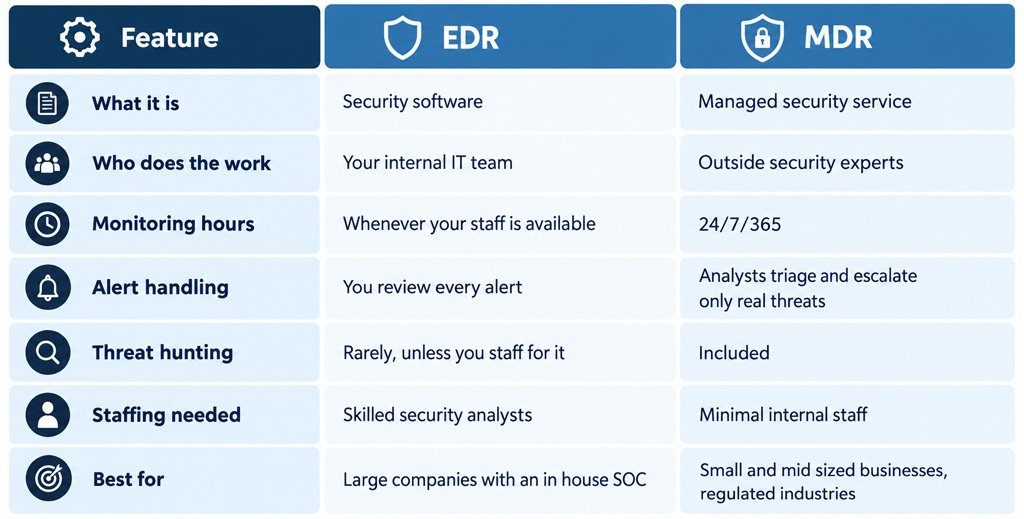
Key Differences Between EDR and MDR
Who does the work
This is the big one. The main difference between EDR and MDR comes down to who’s responsible. Buy EDR, and your team owns every alert. Buy MDR, and the provider owns detection and response while you get the reports.
What happens after hours
Attackers know when offices close. Plenty of ransomware attacks launch on a Friday night or over a holiday weekend for exactly that reason. EDR on its own will spot the activity, but if nobody’s watching, it might be Monday before anyone reads the alert. With 24/7 threat monitoring, someone is there to respond.
What it really costs
On paper, EDR looks cheaper. You pay a license fee per device and that’s it. What’s missing from that number is the people. Covering nights, weekends, and holidays takes several trained analysts, and good ones aren’t cheap or easy to keep. Now weigh that against a breach. IBM’s 2025 Cost of a Data Breach Report put the average breach in the United States at $10.22 million.
How fast threats get stopped
That same IBM report found organizations took 241 days, on average, to identify and contain a breach. That’s about eight months. A team watching around the clock can shrink that window to minutes or hours.
Which One Does Your Business Need?
EDR by itself can work, but only in the right setting. You’d want dedicated security staff (not one IT person juggling everything), real coverage outside business hours, and a tested incident response plan that everyone knows how to follow. Larger companies with their own security team often fit that description.
Most small and mid sized businesses don’t. If that sounds like you, MDR usually makes more sense, especially in healthcare, law, or finance, where regulators expect continuous monitoring. Insurance matters here too. Many carriers have tightened their cyber insurance requirements, and EDR with active monitoring is now a common checkbox on renewal forms.
Here’s the good news. When it comes to EDR vs MDR for small business, you don’t really have to choose. A solid MDR service already includes EDR, so you get the tool and the team in one monthly bill.
How CyberShield IT Helps
We’ve been protecting businesses in Tampa and across Florida since 1996. In that time we’ve watched threats grow from simple viruses into organized ransomware groups, and the way we protect our clients has grown with them.
Our Cybershield services combine NextGen antivirus, endpoint detection, and managed detection and response, with a 24/7/365 security monitoring center keeping watch. That sits alongside our broader cybersecurity services, which cover penetration testing, security audits, and compliance work for HIPAA and NIST. For clients who want one partner for everything, our managed IT services tie everyday technology and security together, so nothing falls through the cracks.
What does that mean for you? Real people watching your systems when you’re not. Threats stopped before they spread. Reports written for business owners, not engineers. Paperwork that helps when your auditor or insurer comes calling. And when you need us, you’re talking to a local team right here in Tampa.
Curious how your current setup stacks up? Book a free consultation or call us at 813.920.0085. We’ll take an honest look and tell you where the gaps are.